
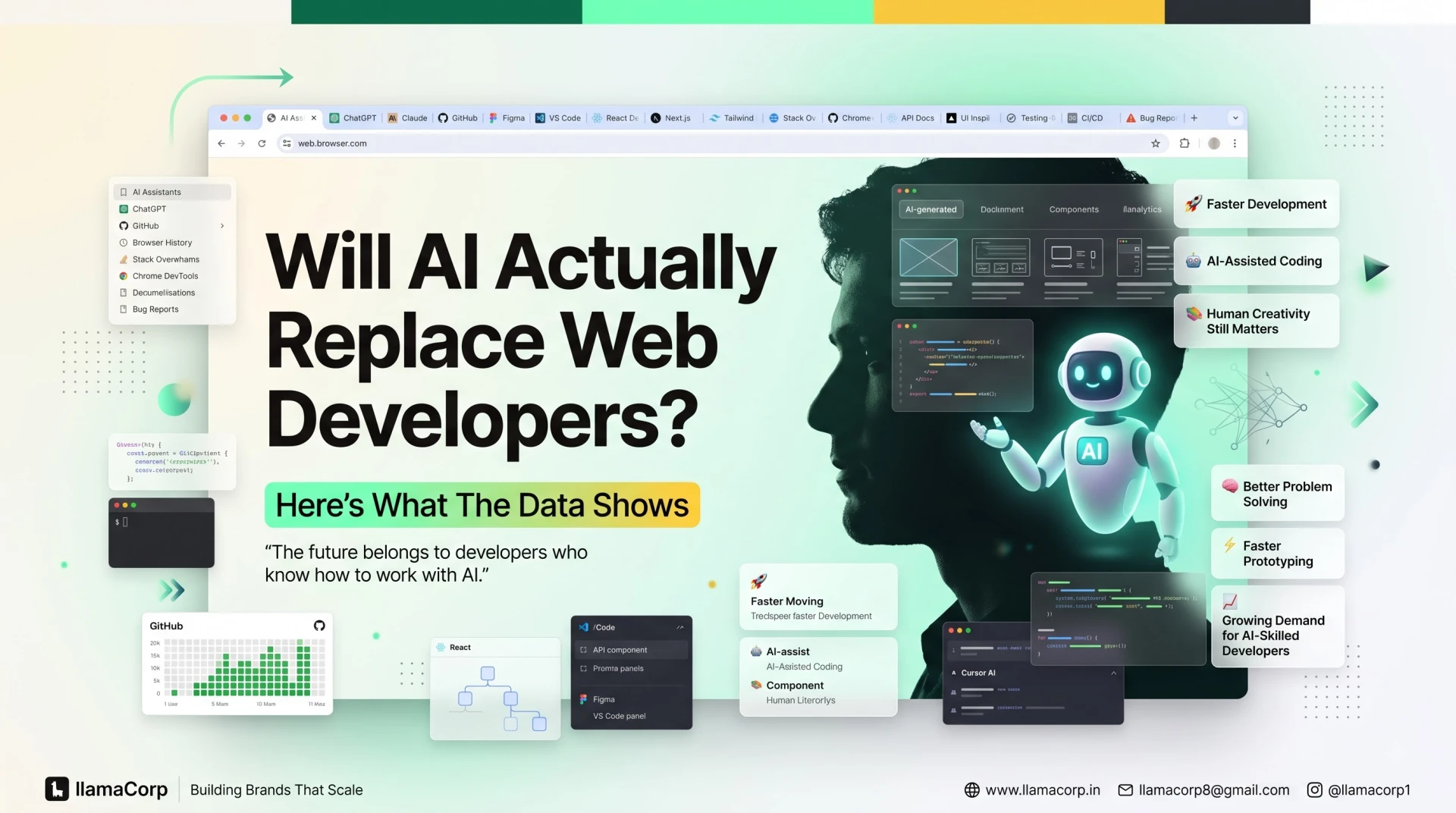
A Mumbai startup founder messaged us last month asking if he even needed to hire a developer anymore, since ChatGPT could "basically build the whole site." Three weeks later he was back, asking us to fix a login system that let any user view any other user's data.
That's the real answer to whether AI replaces web developers. Not a maybe, not a "it depends." AI can write code fast. It cannot yet be trusted to build something that works safely in production without a human checking its work.
Here's what AI coding tools are actually good at, where they fall apart, and what that means if you're a developer in Mumbai worried about your career, or a business owner deciding whether to hire one.
What "AI replacing developers" actually means
When people ask this question, they're usually picturing one of two scenarios: an AI tool that writes an entire application from a text prompt with no developer involved, or an AI tool that makes each individual developer so much faster that a team needs fewer people.
The first scenario is mostly marketing. The second is already happening, and it's a very different story than "developers are becoming obsolete."
Tools like GitHub Copilot, Claude, and Cursor can generate working code for a login form, a REST API endpoint, or a React component in seconds. For well-defined, narrow tasks with clear inputs and outputs, they're genuinely fast and often correct. That's not in dispute.
What's in dispute is whether that same tool can take a vague business requirement, turn it into a secure, maintainable, scalable application, and keep it running as the business changes around it. That's a much bigger job than writing code, and it's where the gap between AI hype and AI reality shows up.
Where AI tools break down on real projects
We use AI coding tools daily at Llamacorp. They speed up our work meaningfully. They also fail in predictable, specific ways on anything beyond a small isolated feature.
State management across a real application. AI tools are trained on millions of small, self-contained code snippets. They're strong at generating a single component or function in isolation. They're weak at reasoning about how twenty different pieces of an application share and mutate state over time, especially in a codebase they didn't write and don't have full context on. Ask an AI to add a feature to an existing 15,000-line codebase and it will often solve the immediate problem while quietly breaking something three files away.
Security decisions. Our client's login bug wasn't a typo. It was a missing authorization check, the kind of thing that requires understanding who should be allowed to see what, not just how to write code that runs without errors. AI tools generate code that looks correct and compiles cleanly while still leaving the door open for a user to access data they shouldn't. Security is a judgment call about trust boundaries, not a syntax problem, and current AI tools don't reliably make that judgment call correctly.
Business logic that isn't written down anywhere. A pricing calculation that changes for enterprise clients. A checkout flow that needs to handle a specific tax rule for Maharashtra. A dashboard that needs to show different data to a store manager versus a regional head. None of this exists in an AI's training data, because it exists only in your business owner's head, or scattered across old emails and Slack messages. Extracting that logic through conversation and turning it into working software is still fundamentally a human skill.
Client communication and requirement gathering. This is the part that never shows up in "AI vs developer" comparisons, but it's most of the actual job. A client says "make it feel more premium." A developer has to translate that into typography choices, spacing, load time expectations, and a dozen other concrete decisions, then check back in and adjust based on feedback that's often contradictory or incomplete. AI tools respond to a prompt. They don't sit in a meeting, read a client's hesitation, and ask the follow-up question that surfaces what the client actually meant.
So what's actually changing for developers
The job is shifting, not disappearing. Writing boilerplate code by hand, the part of development that used to take the most hours for the least thinking, is increasingly handled by AI tools with a developer reviewing and directing the output.
What's becoming more valuable is exactly the stuff AI is bad at: understanding a business well enough to know what to build, making security and architecture decisions that hold up under real usage, and managing the back and forth with a client until the product matches what they actually needed, not just what they first asked for.
For developers in Mumbai specifically, this shows up as a shift in hiring conversations. Agencies and startups here are increasingly looking for developers who can use AI tools to move faster, then apply judgment the tools can't, rather than developers who type out every line by hand or developers who blindly ship whatever an AI generates.
What this means if you're hiring a developer or agency
If you're a business owner in Mumbai considering whether to use an AI tool directly instead of hiring a developer or agency, the honest advice is: it depends on what you're building.
A simple landing page with no login, no database, and no ongoing changes is genuinely something an AI tool can get you most of the way there on, especially if you're comfortable cleaning up the result yourself.
Anything with user accounts, payments, client data, or a business that plans to grow and change over time needs a human reviewing the architecture and security decisions, even if AI tools are writing a chunk of the actual code. That review is where the risk lives, and it's the part that gets skipped when a business tries to go from prompt to production with nothing in between.
Frequently asked questions
Will AI replace web developers by 2030? Unlikely in the sense of eliminating the role. More likely is that AI tools become a standard part of every developer's workflow, similar to how code editors with autocomplete became standard, while the number of developers needed per project shrinks somewhat as individual developers become more productive.
Can AI build a full website without a developer? For very simple, static sites, yes, with real limitations around design quality, security, and how well it holds up as requirements change. For anything with user data, payments, or custom business logic, AI-generated code still needs a developer to review it for security gaps and structural issues before it goes live.
Is it still worth learning web development in 2026? Yes, but the emphasis should shift. Learning to write every line of code from scratch matters less than learning to read code critically, understand system architecture, and know when AI-generated code is wrong. Developers who can direct and audit AI output are more valuable than developers who can't use AI tools at all.
What should a business in Mumbai look for in a web development agency now? Ask directly how they use AI tools in their process, and ask what their review process looks like before code goes live. An agency that uses AI to move faster while still applying human review for security and architecture is a better sign than one that avoids AI entirely, or one that can't explain what checks happen before launch.
If you're weighing AI tools against hiring a developer for your next project, we're happy to talk through what your specific build actually needs. That's a more useful conversation than any AI vs. human headline.

 Start a project