
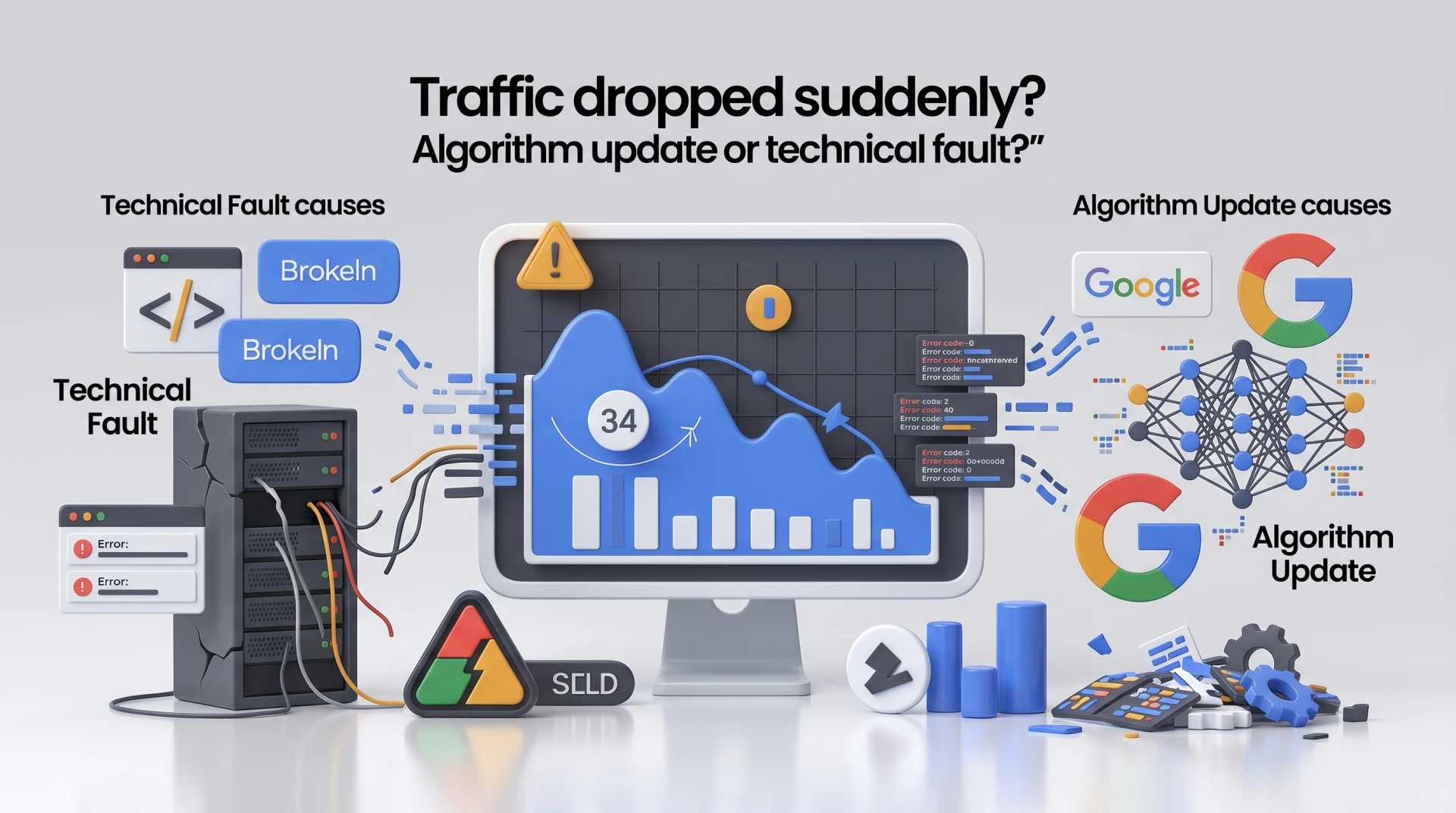
If your website traffic dropped suddenly, you are not alone. Google processes billions of searches every day and adjusts its algorithm constantly. A ranking drop can wipe out months of hard-earned organic growth overnight. The good news is that most ranking drops are recoverable when you follow a structured, evidence-based approach.
This guide walks you through exactly how to diagnose the cause of your traffic loss, fix the underlying issues, and rebuild your rankings systematically.
What Is a Google Ranking Drop? A Google ranking drop occurs when one or more of your web pages fall to a lower position in Google search results, causing fewer people to click through to your site. Even a drop of two or three positions on a high-volume keyword can result in a significant loss of organic traffic, since the top three results on a Google search page capture the majority of clicks.
Ranking drops can be sudden (happening overnight) or gradual (declining steadily over weeks). Each pattern points to a different root cause, and correctly identifying that cause is the most important step in your recovery.
Common Causes of a Google Ranking Drop Before you can fix a traffic loss, you need to understand why it happened. Here are the most common causes:
Google Core Algorithm Updates happen several times per year. Core updates are broad changes to how Google evaluates content quality and relevance. They do not target specific sites, but they can significantly reshuffle rankings across entire industries. Sites that lose ground after a core update typically had pre-existing quality issues that the update surfaced.
Manual Penalties occur when a Google reviewer manually flags your site for violating Google's webmaster guidelines. These are less common than algorithm-driven drops but cause immediate and severe ranking loss. You will receive a notification in Google Search Console if your site has a manual action.
Technical Issues such as pages accidentally blocked by a robots.txt file, broken sitemaps, slow page load times, or pages returning incorrect HTTP status codes can all cause rankings to fall without any algorithm change. These are often the easiest to diagnose and fix.
Content Quality Decline happens when competitors publish stronger, more comprehensive content on the same topics you rank for, gradually pushing your pages down.
Backlink Loss is another underrated cause. If sites that linked to you removed those links or went offline, your domain authority drops and your rankings can follow.
Core Web Vitals Failures matter more than ever. Google uses real-world performance data including Largest Contentful Paint (LCP), Interaction to Next Paint (INP), and Cumulative Layout Shift (CLS) as ranking signals. If your scores decline, your rankings can too.
Step 1: Pinpoint the Exact Date of the Drop Open Google Search Console and navigate to the Performance report. Set the date range to the last 90 days and look for the specific date when impressions and clicks began to fall. Write this date down.
Then cross-reference it with Google's confirmed algorithm update history. Google announces core updates, spam updates, and helpful content updates on its Search Status Dashboard. If your drop coincides with a confirmed update, you have your primary culprit. If there was no update on that date, look inward at your own site changes, such as a CMS migration, a hosting change, or content deletions.
Step 2: Diagnose the Problem with These Tools Google Search Console is your first stop. Check:
The Manual Actions report for any penalties
The Pages report for any sudden increase in "Not Indexed" or "Crawled but not indexed" pages
The Core Web Vitals report for performance regressions
The Coverage report for crawl errors
Google Analytics (GA4) lets you identify which pages lost the most traffic and whether the loss came from organic search specifically or from all channels.
Screaming Frog or Sitebulb can crawl your entire site the way Googlebot does, revealing broken links, missing meta tags, duplicate content, and redirect chains.
Ahrefs or Semrush will show you which keywords you dropped, which competitors gained those positions, and whether you have lost any referring domains recently.
Step 3: Fix Content Quality Issues This is the most common recovery lever after a core algorithm update. Google's Helpful Content System evaluates whether your content was primarily made for people or for search engines. Here is how to audit and improve it:
Assess every impacted page for information depth. Does the page actually answer the reader's question thoroughly? A good test: after reading your page, would a user still need to search for more information on the same topic? If yes, your content is thin.
Rewrite for expertise and firsthand experience. Google's Quality Rater Guidelines explicitly reward content that demonstrates real-world experience. Add original insights, first-person observations, case studies from your own work, or data specific to your industry. Llamacorp's most successful content pieces, for example, combine platform-specific findings with practical recommendations that readers cannot find anywhere else.
Consolidate duplicate content. If you have multiple pages targeting the same keyword, Google will often rank none of them well because they compete with each other. Merge related pages into a single, authoritative piece and redirect the old URLs.
Update outdated statistics and references. Pages that cite data from three or more years ago send a signal of low freshness. Update figures, add a "last updated" date, and reflect any changes in the industry landscape.
Remove or improve underperforming pages. Pages with near-zero traffic and no strategic purpose can drag down the overall quality signal of your entire domain. Audit your lowest-performing pages and either substantially improve them or remove them and redirect the URLs.
Step 4: Resolve Technical Issues Even excellent content will not rank if Googlebot cannot properly access, crawl, and index it. Run through this technical checklist:
Check your robots.txt file to ensure you have not accidentally blocked key pages or directories from being crawled. A single misplaced line in robots.txt can deindex your most important content.
Audit your sitemap. Submit a fresh XML sitemap to Google Search Console and confirm all your priority URLs are included and returning a 200 OK status.
Fix Core Web Vitals. Use Google PageSpeed Insights to measure your LCP, INP, and CLS scores on both mobile and desktop. Common fixes include compressing images, removing render-blocking JavaScript, and implementing lazy loading.
Resolve redirect chains. Multiple sequential redirects (e.g., A redirects to B, B redirects to C) dilute link equity and slow page load time. Flatten all redirect chains to a single hop.
Check for hreflang errors if your site has international or multi-language versions. Incorrect hreflang implementation is a surprisingly common cause of ranking instability.
Step 5: Rebuild and Diversify Your Backlink Profile If your ranking drop coincides with a loss of referring domains, you will need to actively rebuild your link profile. Here is a focused approach:
Audit what you lost. Use Ahrefs or Semrush to see exactly which referring domains disappeared. Reach out to sites that linked to you previously and ask them to restore the links if appropriate.
Publish link-worthy assets. Original research, free tools, comprehensive guides, and industry surveys naturally attract backlinks. A single well-researched annual report can generate dozens of organic referring links.
Reclaim unlinked mentions. Use Google Alerts or a media monitoring tool to find sites that mention your brand without linking to you. A polite outreach email asking for a link has a high conversion rate in this context.
Disavow toxic links only if necessary. Google is quite good at ignoring low-quality links on its own. Only disavow links if you have received a manual penalty for unnatural links, or if you have clear evidence of a negative SEO attack.
How Long Does Google Ranking Recovery Take? Recovery timelines vary significantly depending on the cause:
A technical fix such as correcting a robots.txt error or fixing a redirect can result in ranking recovery within days to weeks, once Google recrawls the affected pages.
A content quality improvement after a Google core update typically takes one to three months to be reflected in rankings. Google evaluates improvements at the next core update cycle, though improvements can sometimes be recognized sooner through regular quality assessments.
A manual penalty removal takes several weeks after you submit a reconsideration request to Google, assuming the request is approved.
A backlink profile rebuild is the slowest recovery path and can take three to six months to show meaningful ranking improvement.
Patience is essential. Avoid making multiple large changes simultaneously, as this makes it impossible to know which change caused any improvement or decline.
How to Prevent Future Google Ranking Drops The best recovery strategy is avoiding the drop in the first place. Here are the most effective long-term safeguards:
Build a content monitoring routine. Review your Search Console performance data weekly. Set up alerts for any sudden impression drops on key pages.
Keep content fresh. Schedule quarterly content audits where you review and update your most important pages. Add new data, improve examples, and expand sections where competitors have grown stronger.
Diversify your traffic sources. A website that depends entirely on Google organic traffic is extremely vulnerable. Build email subscribers, social media audiences, and direct traffic through brand awareness so that an algorithm update does not eliminate your entire visitor base.
Follow Google's Search Central Blog and Status Dashboard. Google announces confirmed updates and provides guidance. Following these directly means you are not relying on second-hand interpretations.
Invest in technical SEO hygiene. Run a full technical audit at least twice per year. Catching issues like page speed regressions or crawl errors early prevents them from compounding into ranking problems.
Frequently Asked Questions Can a Google ranking drop be permanent?
In most cases, no. Algorithm-driven drops are recoverable when the underlying content or technical issues are fixed. However, if a site has relied on manipulative SEO tactics for years, recovery can be very difficult because the site's overall trust score is low. Sites penalized for link spam, cloaking, or auto-generated content face the steepest recovery challenges.
Should I change my URL structure to recover rankings?
Generally, no. Changing URLs resets the ranking history of those pages and adds risk. Only restructure URLs if your current structure has clear crawlability or duplicate content problems that cannot be resolved another way. Always implement 301 redirects from old URLs to new ones.
Do social media signals affect Google rankings?
Google has stated that social media signals such as likes, shares, or followers are not direct ranking factors. However, strong social distribution can drive real traffic, earn backlinks, and build brand awareness, all of which indirectly support better rankings over time.
What is the difference between a Google penalty and an algorithm update?
A penalty is a deliberate action taken against your site, either manually by a Google reviewer or automatically by a spam detection algorithm such as SpamBrain. An algorithm update is a change to how Google evaluates all content broadly. Penalties require active remediation and a reconsideration request. Algorithm update impacts are addressed by improving your content and site quality over time.
Does recovering deleted content help rankings?
Yes, if those pages had inbound links, traffic, or ranking history. Restoring deleted pages and ensuring they are properly indexed can recover lost rankings relatively quickly. If restoration is not possible, use 301 redirects to send the link equity to the most relevant alternative page.
Key Takeaways Recovering from a Google ranking drop requires a methodical approach. Start by identifying the exact date and likely cause of the drop, then work through technical, content, and backlink issues in a structured way. Avoid making sweeping changes all at once, and give Google time to recrawl and re-evaluate your site after each fix.
The sites that recover fastest are those that treat rankings as a lagging indicator of content quality, technical health, and genuine user value rather than as a target to be gamed.
If you need help auditing your site or building a structured recovery plan, the team at Llamacorp is available to walk you through the process.
Llamacorp helps businesses grow through transparent, data-driven digital strategy. Explore our resources or get in touch to learn how we work

 Start a project